
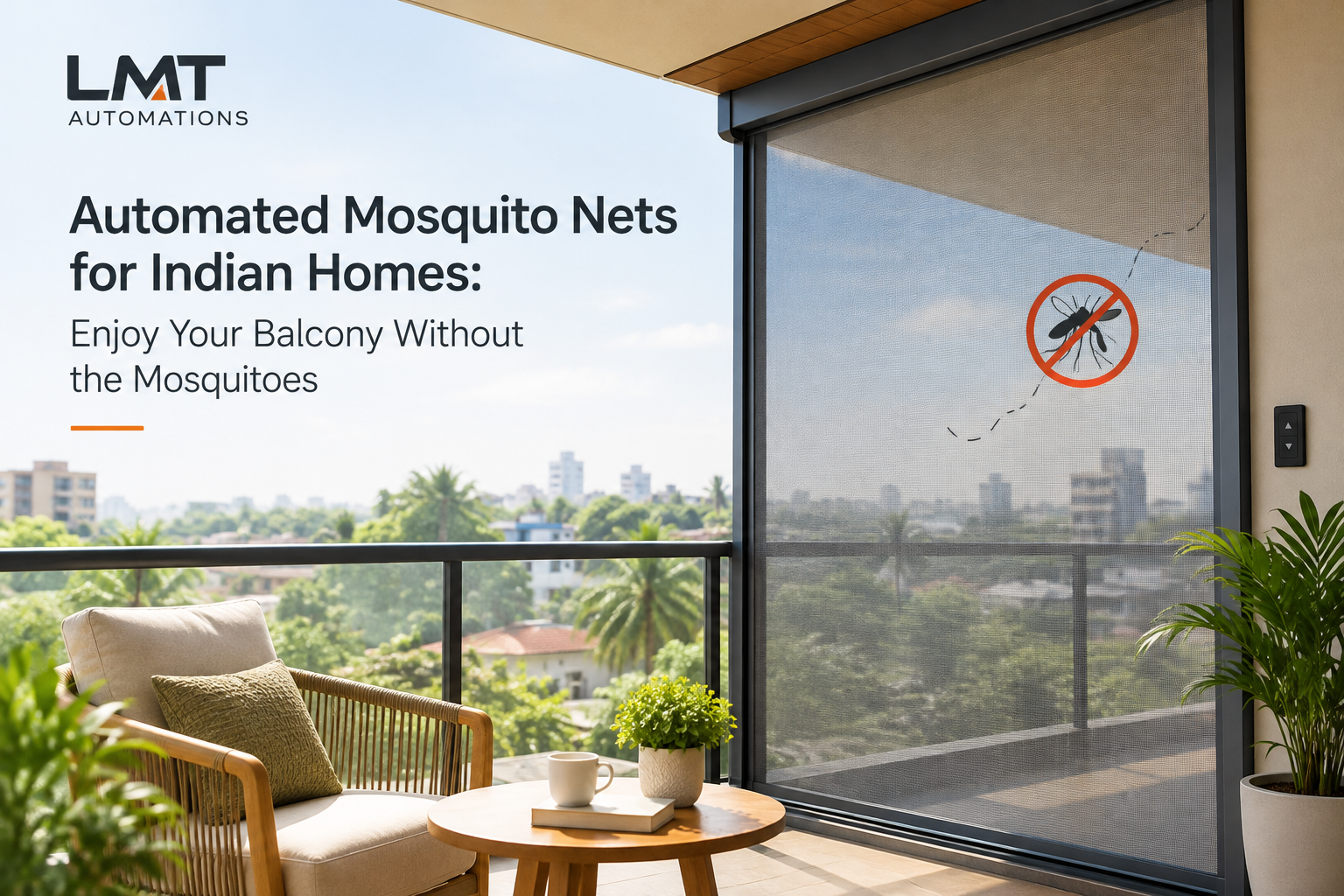
Balcony time… without the mosquito squad !
There is something special about keeping your balcony open in the evening. A gentle breeze, a cup of tea, a favourite book, or simply enjoying the view after a long day can make a home feel more relaxing. But during mosquito season, leaving the balcony doors open can also invite unwanted visitors into your living space.
For many Indian homeowners, mosquitoes are more than a minor inconvenience. They can interrupt sleep, disturb family time, and make it difficult to enjoy fresh air indoors. Traditional mosquito nets and fixed screens can help, but they may not always suit modern balconies, large openings, or homes where flexibility and aesthetics matter.
This is where automated mosquito screens for Indian homes offer a practical alternative. With motorised screening solutions such as LMT Automations’ ALUTECH ZIP Screens, homeowners can create a protective barrier across suitable balcony and window openings while maintaining a connection with the outdoors.
The idea is simple: enjoy your balcony, fresh air, and the view without leaving the entrance unnecessarily exposed to mosquitoes.
Why Are Mosquito Screens Important for Indian Homes?
India’s varied climate, monsoon rains, warm temperatures, and humid conditions in many regions can create favourable environments for mosquitoes. Their presence can become particularly noticeable around residential areas with gardens, balconies, open terraces, and nearby sources of standing water.
In apartments and independent houses alike, balconies often become the natural meeting point between indoor comfort and the outdoors. They allow daylight and ventilation, provide a place to unwind, and can make compact living spaces feel more open.
However, an unprotected balcony opening can also become an entry point for mosquitoes and other flying insects.
Keeping balcony doors closed may reduce their entry, but it can limit ventilation and prevent homeowners from enjoying the space as intended. Conventional mosquito nets provide another option, although some fixed designs may not offer the flexibility required for modern architecture.
A well-planned mosquito screening solution helps balance these competing needs. It allows homeowners to create a screened opening when required and retract the screen when an unobstructed view or open access is preferred.
For households looking to improve everyday comfort without compromising the appearance of their interiors, automated screening is worth considering.
What Are Automated Mosquito Nets?
Automated mosquito nets are retractable screening systems that use a motor to raise, lower, extend, or retract a screen across a suitable opening. Depending on the system’s design, the screen can be operated using a remote control, wall switch, or another compatible control arrangement.
Unlike a permanently fixed mesh, a retractable system can be moved out of the way when it is not needed. This makes it particularly useful for homeowners who want greater control over their balcony, window, or outdoor living areas.
The term automated mosquito net can refer to different products, including dedicated insect-screen systems and motorised zip-screen blinds. These products are not identical, so the selected mesh, side guides, sealing details, and intended application matter.
For example, a motorised zip-screen system can hold its fabric within guided side channels to help maintain alignment and reduce gaps along the sides. When specified with a suitable insect-screen mesh and installed correctly, it can help create a barrier against mosquitoes entering through the screened opening.
This distinction is important: not every zip screen is designed primarily for insect protection. Homeowners should confirm that the selected ALUTECH ZIP Screen configuration uses an appropriate mesh for their mosquito-screening requirements.
How Do LMT Automations’ ALUTECH ZIP Screens Help?
LMT Automations offers ALUTECH ZIP Screens as a solution for creating more comfortable, functional outdoor living spaces. When configured with a suitable insect-screen fabric, a zip-screen system can be considered for balcony openings where homeowners want to enjoy ventilation while reducing mosquito entry.
Here is how this type of screening can improve everyday living.
1. Enjoy Fresh Air Without Leaving the Balcony Fully Exposed
One of the biggest advantages of a screened balcony is the ability to enjoy natural ventilation without leaving the opening completely unprotected.
During pleasant mornings and evenings, homeowners may prefer to keep balcony doors open rather than depend entirely on air conditioning. A suitable insect-screen mesh allows air to pass through while helping keep mosquitoes outside.
The amount of airflow depends on the mesh material, its openness, the wind conditions, and the size of the opening. Nevertheless, a well-selected screen can offer a useful balance between ventilation and insect protection.
With ALUTECH ZIP Screens configured for this application, balcony time can become more comfortable without making the space feel permanently enclosed.
2. Motorised Convenience at the Touch of a Button
Traditional mosquito nets often require manual handling, sliding panels, or fixed installation. Automated screening introduces another level of convenience.
Depending on the selected motor and control system, homeowners can extend or retract the screen using a compatible remote control or wall switch. This is particularly useful for large balcony openings, where manually handling a screen may be less convenient.
Imagine sitting down for your evening tea and lowering the screen when mosquitoes become active. When you want an unobstructed view or easier access to the balcony, you can retract it again.
The goal is to make everyday home management simpler, with screening that adapts to your routine.
3. A Cleaner Look for Modern Balconies
Contemporary homes increasingly treat balconies as extensions of the living room rather than separate utility areas. Furniture, plants, lighting, and carefully selected finishes all contribute to the overall appearance.
A bulky or permanently visible screen may not suit every design preference.
Retractable zip-screen systems offer a more discreet alternative when the screen is not required. Depending on the installation and housing design, the system can integrate with the surrounding architecture while keeping the mesh out of the way when retracted.
For apartments, villas, and premium residences, this combination of function and appearance can be an important consideration.
The objective is not simply to keep mosquitoes out. It is to make the balcony more usable while respecting the design of the home.
4. A Practical Option for Large Openings
Balconies often have wide sliding-door openings, full-height glazing, or floor-to-ceiling access points. Choosing a screen for these areas requires attention to dimensions, mounting conditions, and the way the doors are used.
Motorised screening may be suitable for openings where a small conventional net would be impractical or inconvenient. The final suitability depends on the system’s maximum dimensions, wind exposure, fabric selection, and installation requirements.
LMT Automations’ ALUTECH ZIP Screens can be assessed for appropriate balcony applications, helping homeowners explore a solution that fits the space rather than relying on a one-size-fits-all approach.
A site assessment is especially valuable for high-rise balconies, unusually wide openings, and installations exposed to strong winds.
5. Help Maintain a Comfortable Indoor Environment
Mosquitoes entering through balcony doors can quickly turn a relaxing evening into an uncomfortable experience. A suitable insect screen helps reduce the opportunity for mosquitoes to enter through the protected opening.
This can be particularly helpful in homes where family members regularly move between indoor and outdoor areas.
However, screening should form part of a broader mosquito-control approach. Water stored in plant trays, uncovered containers, blocked drains, and other sources of standing water can support mosquito breeding. Regularly removing standing water and keeping doors and windows screened where appropriate can improve protection.
Automated screens are not a replacement for these preventive measures, but they can be a useful addition to a home’s overall mosquito-management strategy.
Why Choose Automated Mosquito Screens Instead of Fixed Nets?
Fixed mosquito nets can be effective when correctly selected and installed. They may also be an economical choice for smaller windows or openings that do not require frequent access.
However, a retractable automated system offers different advantages for homeowners who value flexibility.
| Feature | Fixed mosquito net | Automated zip-screen system |
|---|---|---|
| Operation | Usually remains in place | Can be extended or retracted |
| Convenience | Depends on the design | Motorised operation with compatible controls |
| View when not required | Mesh may remain visible | Screen can be retracted |
| Large openings | Depends on the frame and design | May suit selected wider openings, subject to specifications |
| Appearance | Fixed frame or mesh is visible | Can offer a more discreet appearance when retracted |
| Installation | Depends on the opening | Requires suitable mounting, motor, guides, and power arrangements |
Neither option is automatically better for every home. Fixed nets may be sufficient for some windows, while automated screening can be attractive for larger balconies and openings where flexibility is a priority.
The right choice depends on the opening size, frequency of use, budget, design preferences, and whether the selected fabric is specifically suitable for insect protection.
Where Can Automated Mosquito Screens Be Used?
Although balconies are a natural application, retractable screening can be considered for several areas of a home.
Apartment Balconies
Apartment balconies often connect the living room or bedroom directly to the outdoors. A suitable zip-screen installation can help create a screened opening while preserving the option to retract the screen when required.
In high-rise apartments, wind exposure and building restrictions must be assessed before choosing the system.
Villa Patios and Garden-Facing Openings
Villas with garden-facing doors, covered patios, or outdoor seating areas can benefit from screening that supports comfortable use of these spaces.
A properly specified insect mesh can help reduce mosquito entry through the protected opening, making the area more practical for everyday relaxation.
Large Windows and Sliding Doors
Wide windows and sliding-door openings can be challenging to cover with conventional nets, depending on their configuration.
Motorised screening may provide an alternative where the opening dimensions and installation conditions are suitable. Careful measurement is essential to ensure proper operation and adequate coverage.
Covered Outdoor Living Areas
Covered verandas and selected outdoor seating spaces may also be suitable for screening. The final system should be chosen according to exposure, mounting conditions, intended use, and the manufacturer’s technical specifications.
For every application, the important first step is to identify the type of protection required and select a screen designed to deliver it.
Choosing the Right Automated Mosquito Net for Your Home
Before investing in an automated mosquito screen, consider the following factors.
Mesh type: If mosquito protection is the primary objective, confirm that the selected mesh is designed for insect screening. Mesh openness affects airflow, visibility, and the size of insects it can help exclude.
Opening dimensions: Measure the width and height of the balcony or window opening. The screen must be compatible with the required dimensions and installation conditions.
Side guides and sealing: Gaps around the screen can allow mosquitoes to enter. Check the guide design, bottom closure, installation tolerances, and other potential entry points.
Motor and controls: Consider whether a wall switch, remote control, or compatible smart-control integration is appropriate for your home. Confirm the actual control options available for the selected configuration.
Wind exposure: Balconies in high-rise buildings and exposed locations may experience strong or gusty winds. Ask the installer to assess wind conditions and verify the system’s operating limits.
Maintenance: Ask about cleaning instructions for the selected fabric and the care required for the guides and moving components. Regular maintenance can help preserve smooth operation.
Professional installation: Accurate measurement, secure mounting, correct motor setup, and appropriate screen tension all contribute to reliable performance. A professional assessment helps identify installation challenges before work begins.
Taking time to evaluate these factors can help you select a screening solution that works for both your lifestyle and your home’s architecture.
Are Automated Mosquito Screens Worth It for Indian Homes?
For homeowners who regularly use their balconies, the value of automated mosquito screens extends beyond insect protection.
A balcony is often one of the most versatile spaces in a home. It can serve as a morning coffee corner, a small garden, a place to read, or an evening retreat after a busy day. Yet if mosquitoes make the area uncomfortable, the balcony may remain unused for much of the year.
A retractable screening system can help make this space more practical by allowing homeowners to adapt the opening to their needs. The screen can be used when insect protection is required and retracted when a more open arrangement is preferred.
The convenience may be especially appealing in modern apartments, premium residences, and homes with large balcony doors.
The investment makes the most sense when the system is selected for the correct purpose, professionally installed, and maintained according to the manufacturer’s recommendations. Homeowners should compare the cost with their actual usage, the available alternatives, and the expected benefits for their particular space.
Enjoy Balcony Time, Not Mosquito Time, with LMT Automations
A comfortable home should allow you to enjoy the outdoors without constantly worrying about mosquitoes entering your living space.
With LMT Automations’ ALUTECH ZIP Screens, homeowners can explore a motorised screening solution for suitable balcony and window openings. When configured with appropriate insect-screen mesh, the system can help create a protective barrier while allowing ventilation and maintaining the view.
From quiet mornings to relaxed evenings, the aim is to make your balcony more enjoyable, with screening that fits your home’s design and your daily routine.
Because sometimes, all you want is a little fresh air, a beautiful view, and a peaceful cup of tea — without the mosquito squad.
Keep the balcony open. Keep the comfort in. Leave the mosquitoes outside.
Explore screening solutions from LMT Automations and enquire about ALUTECH ZIP Screens for your home.
Frequently Asked Questions
1. What are automated mosquito nets?
Automated mosquito nets are retractable screens operated by a motor. Depending on their design and mesh specification, they can help prevent mosquitoes from entering through protected windows, balconies, and other suitable openings.
2. Are ALUTECH ZIP Screens suitable for mosquito protection?
ALUTECH ZIP Screens can be considered for mosquito protection when the selected configuration uses suitable insect-screen mesh and is installed to minimise gaps. Confirm the available mesh options and intended application with LMT Automations before selecting a system.
3. Can automated mosquito screens be installed on apartment balconies?
Potentially, yes. Suitability depends on the balcony’s dimensions, mounting surfaces, wind exposure, building rules, and the selected system’s technical specifications. A site assessment is recommended.
4. Do motorised mosquito screens allow fresh air to enter?
Yes, when an appropriate breathable mesh is selected, air can pass through the screen. The actual airflow depends on the mesh construction, opening size, and surrounding conditions.
5. Can automated mosquito nets be retracted when not in use?
Yes. Retractable motorised systems are designed to move the screen out of the opening when required. The available operating method depends on the motor and controls selected.
6. Do automated mosquito screens block the balcony view?
The mesh remains across the opening when the screen is extended, so visibility depends on the fabric’s colour, openness, and construction. Retracting the screen restores a more unobstructed opening.
7. Are automated mosquito screens suitable for large sliding doors?
Some systems can accommodate selected large openings, subject to maximum dimensions, structural support, and installation requirements. The manufacturer’s specifications should be checked before ordering.
8. Do automated mosquito nets require regular maintenance?
Yes. Periodic cleaning and inspection of the mesh, side guides, and moving components help maintain performance. Follow the manufacturer’s instructions and avoid cleaning products that could damage the fabric or mechanism.
9. Can automated mosquito screens replace all mosquito-control measures?
No. Screens help reduce mosquito entry through protected openings but do not eliminate mosquitoes already inside or prevent breeding elsewhere. Removing standing water and using other appropriate preventive measures remain important.
10. How can I enquire about automated mosquito screens from LMT Automations?
Visit https://lmtautomations.com/ to explore LMT Automations’ solutions and enquire about ALUTECH ZIP Screens. Share your opening dimensions, application, and preferred controls so the team can help assess a suitable configuration.
Leave a Reply
You must be logged in to post a comment.