
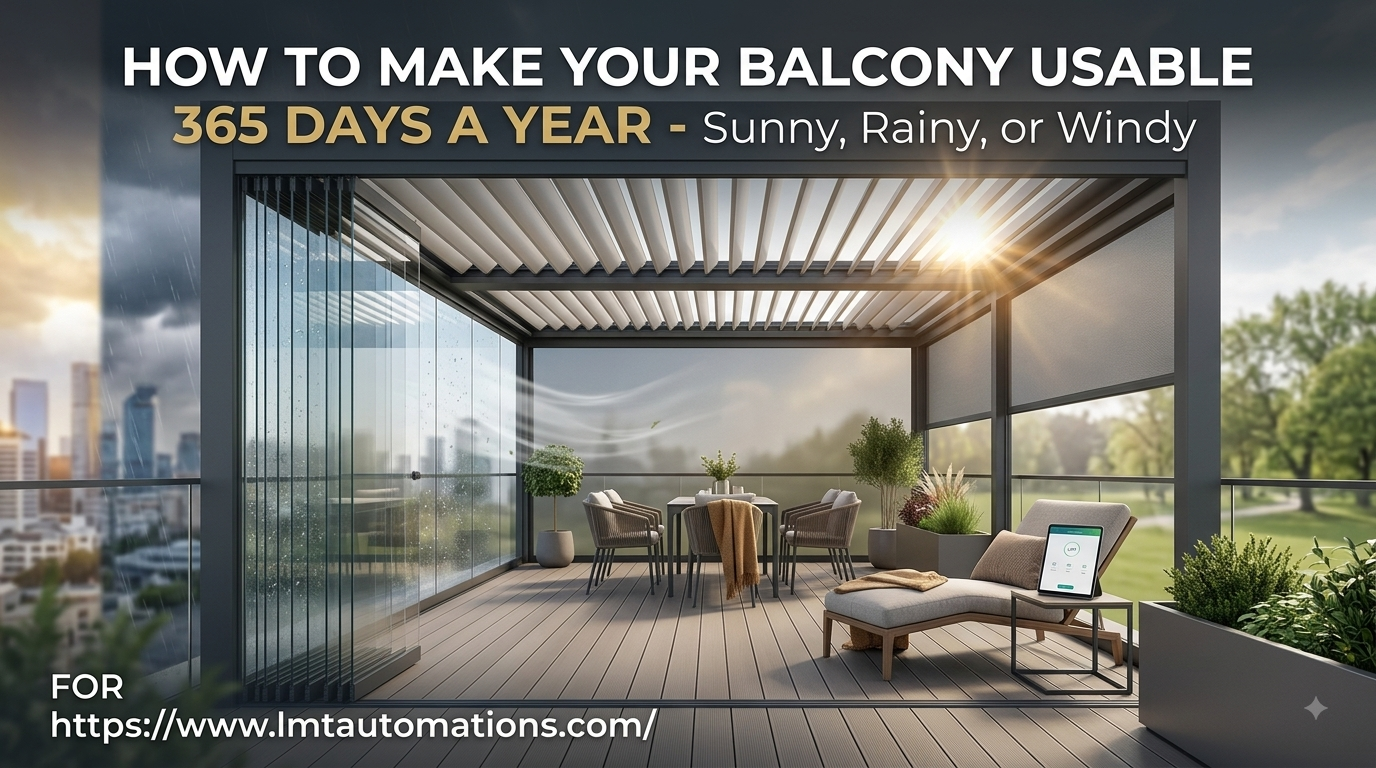
For most homeowners, a balcony is little more than a place to dry laundry, store a few plants, or stand for a quick breath of fresh air. But what if that same space could become your favourite spot in the house a place you actually want to spend time in, no matter what the sky is doing?
The truth is, most balconies go unused not because they lack potential, but because they lack protection. A sunny afternoon turns into a scorching sauna. A light drizzle sends you running back indoors. A gusty evening makes sitting outside impossible. With the right outdoor solutions, though, your balcony can be transformed into a comfortable, functional, and beautiful extension of your home usable in every season and every kind of weather.
In this guide, we’ll walk through four practical upgrades that make an all-weather balcony possible: bioclimatic pergolas, zip screens, uplifting glass windows, and vertical louvres. Whether you live in an apartment, a villa, or run a café or commercial space, these solutions can help you reclaim your outdoor area for good.
Why Most Balconies Go Unused
Before diving into the solutions, it helps to understand the problem. Balconies are exposed to the elements in a way that indoor rooms aren’t, which means they’re constantly battling one (or several) of these issues:
- Heat – Direct sunlight can make a balcony unbearable during peak afternoon hours.
- Rain – Even a covered balcony can suffer from wind-driven rain soaking furniture and flooring.
- Wind – Strong gusts make sitting, dining, or relaxing outside uncomfortable or even unsafe for loose items.
- Dust and pollution – Urban balconies often collect dust, which discourages regular use.
- Insects and birds – Mosquitoes and birds can turn an otherwise pleasant evening into an irritating one.
- Lack of privacy – Open balconies, especially in apartment complexes, can feel too exposed for comfortable relaxation.
The good news? Every one of these problems has a design solution. Let’s look at how.
1. Bioclimatic Pergola: Shade or Open Skies, On Demand
A bioclimatic pergola is one of the smartest investments you can make for an outdoor space. Unlike a fixed roof, it features adjustable louvred blades that open and close depending on your needs.
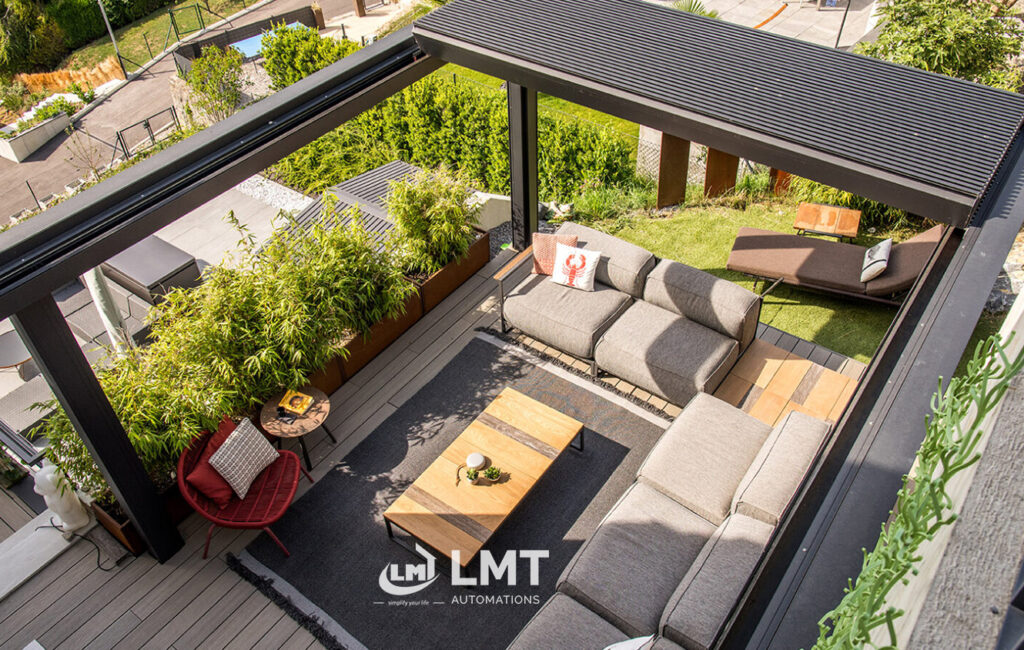
How it helps:
- On sunny days, close the blades to create instant shade and reduce heat buildup.
- On clear evenings, open them up to enjoy an unobstructed view of the sky.
- During light rain, the closed position keeps your furniture and flooring dry.
- Many bioclimatic pergolas also come with integrated rain sensors that automatically close the blades if weather changes while you’re away.
This flexibility means your balcony is never dictated by the weather you decide how much sun, shade, or open air you want at any given moment. It’s a permanent structure that adapts daily, making it ideal for balconies, terraces, and rooftop lounges alike.
2. Zip Screens: Block Heat, Dust, Mosquitoes, and Birds
If a pergola handles what’s happening above you, zip screens handle what’s coming at you from the sides. These are tensioned, track-guided fabric or mesh screens that can be lowered or raised as needed, sealing the sides of your balcony without blocking the view.
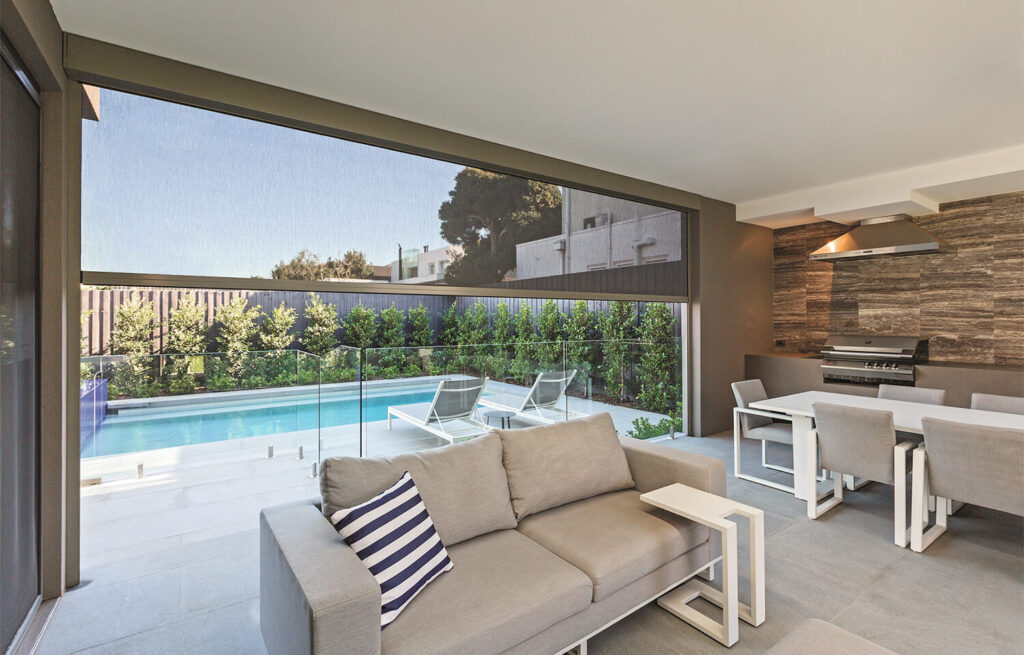
Key benefits:
- Heat control – Reduces solar heat gain, keeping the space cooler even in direct sun.
- Dust protection – Acts as a barrier against blown dust and debris, especially useful in urban or high-rise settings.
- Mosquito and insect protection – Fine mesh options keep bugs out while still allowing airflow.
- Bird control – Prevents birds from nesting or entering the balcony space.
- Privacy – Certain screen densities allow you to see out while limiting visibility from outside.
Because zip screens run along a guided track, they stay taut even in windy conditions, unlike traditional curtains or blinds that flap and wear out quickly. They can be manually operated or motorized for one-touch convenience.
3. Uplifting Glass Windows: Uninterrupted Views, Full Weather Protection
For balconies that need complete protection from rain and wind without sacrificing the view, uplifting (or frameless stacking) glass windows are an excellent choice. These systems use large glass panels that slide and stack neatly to one side, allowing you to fully open or fully enclose your balcony.

Why homeowners love them:
- Weatherproofing – When closed, glass windows create a fully sealed barrier against rain, wind, and cold.
- Uninterrupted views – Slim, minimal framing means your view stays the focal point, not the structure.
- Noise reduction – Glass panels also help dampen outside noise, useful for balconies facing busy streets.
- Flexible use – Open them completely in pleasant weather to merge indoor and outdoor space, or close them fully during a storm.
Glass windows are particularly popular for balconies used as extended living rooms, home offices, or dining nooks, since they let you enjoy the view year-round regardless of what’s happening outside.
4. Vertical Louvres: Precise Control Over Sunlight, Airflow, and Privacy
Vertical louvres are adjustable slatted panels typically made from aluminium, wood-look composite, or similar durable materials that rotate to control how much light, air, and visibility passes through.

What makes them valuable:
- Sunlight control – Angle the louvres to block harsh midday sun while still letting in soft, diffused light.
- Airflow management – Unlike solid walls, louvres allow ventilation even when mostly closed.
- Privacy on demand – Rotate them fully closed for complete privacy, or open for an unobstructed view.
- Aesthetic appeal – Available in multiple finishes, louvres also add a clean, modern architectural element to your balcony.
Vertical louvres work beautifully alongside pergolas and zip screens, giving you layered control shade from above, screening from the sides, and precise light control on the vertical plane.
Designing Your All-Weather Balcony: Where to Start
You don’t need to install all four solutions at once. Most homeowners start with one or two based on their biggest pain point:
- If heat is your main issue → Start with a bioclimatic pergola.
- If insects, dust, or birds are the problem → Zip screens should be your first upgrade.
- If you want full weatherproofing and unobstructed views → Uplifting glass windows are worth the investment.
- If privacy and light control matter most → Vertical louvres offer the most flexibility.
For maximum year-round comfort, many homeowners eventually combine two or more of these for example, a bioclimatic pergola for overhead shade paired with zip screens or glass windows for side protection.
These solutions aren’t limited to residential balconies either. Villas, apartments, cafés, restaurants, and commercial outdoor seating areas all benefit from the same principles protected, flexible outdoor space that performs regardless of the forecast.
Ready to transform your balcony into something truly functional?
Your balcony doesn’t have to sit empty every time the weather turns. With thoughtful additions like a bioclimatic pergola, zip screens, uplifting glass windows, and vertical louvres, you can build an outdoor space that works with the weather instead of against it sunny, rainy, or windy. The result isn’t just a more usable balcony. It’s an entirely new room in your home, one that adds comfort, value, and everyday enjoyment.
LMT Automations brings expert entrance automation solutions to homes, villas, apartments, cafés, and commercial spaces across Kerala, Bangalore, Chennai, and Hyderabad. From automatic gates and doors to bioclimatic pergolas, zip screens, glass enclosures, and vertical louvres, our team designs and installs solutions tailored to your space and your climate. Don’t let your outdoor or entry areas sit underused — get in touch with LMT Automations today for a free consultation and discover how much more your space can do for you.
Frequently Asked Questions (FAQs)
1. What is a bioclimatic pergola, and how is it different from a regular pergola? A bioclimatic pergola has adjustable louvred blades that open and close to control sunlight, shade, and rain exposure, unlike a fixed pergola which offers no flexibility.
2. Can zip screens withstand strong winds? Yes. Because zip screens run along a guided track system, the fabric stays tensioned and secure even in windy conditions, unlike loose curtains or blinds.
3. Do glass balcony enclosures reduce natural light? No. Uplifting glass windows use slim framing and large glass panels specifically designed to maximise light and preserve views while offering full weather protection.
4. Are vertical louvres suitable for small balconies? Yes, vertical louvres are especially well-suited to compact spaces since they don’t require much depth and can be adjusted to manage light and privacy without taking up floor space.
5. Can these balcony solutions be motorized? Many bioclimatic pergolas, zip screens, and louvre systems are available with motorized operation, allowing remote or app-based control.
6. Will these upgrades work for apartments, not just villas? Absolutely. All four solutions pergolas, zip screens, glass windows, and louvres can be customised for apartment balconies, villa terraces, cafés, and commercial spaces.
7. How do I choose between zip screens and glass windows? Zip screens are ideal for airflow, insect and dust protection, and partial privacy. Glass windows are better if you want complete weatherproofing with an unobstructed view. Many spaces benefit from combining both.
8. Do these solutions help reduce indoor heat as well? Yes. By blocking direct sun and reducing heat buildup on the balcony, solutions like pergolas and zip screens can also help keep adjoining indoor rooms cooler.
9. Are these outdoor solutions weather-resistant long-term? Yes, these systems are built with durable, weather-resistant materials such as aluminium framing and UV-treated fabrics, designed to withstand sun, rain, and wind over the long term.
10. Can I install just one solution now and add others later? Yes. Most homeowners start with a single upgrade based on their biggest concern (heat, privacy, rain, etc.) and add complementary solutions like screens or louvres over time.